

Trinity Health Michigan:
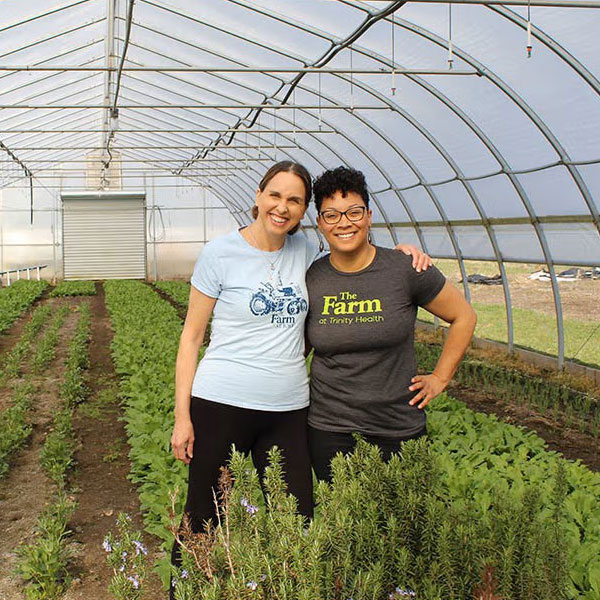
Growing Food at the Hospital to Humanize Care
Trinity Health is a national Catholic health system with deep roots in community-based care and a long history of addressing social and environmental drivers of health. Within that context, Trinity Health Michigan began asking a practical question more than a decade ago:
What would it look like if access to healthy food were woven directly into the care experience, not referred out, not abstracted, but tangible and immediate?
The answer took shape in 2010, when Trinity Health Michigan launched a hospital-based farming model that treated food not as an external social service, but as part of care delivery itself. Over time, the program evolved, and in 2021, the program expanded to Pontiac, Michigan—a community facing profound disparities in food access and life expectancy. In Pontiac, leaders saw that while food access organizations were active, many residents still faced barriers to engagement. Locating food access within the hospital created a neutral, trusted place to seek help, one that lowered stigma and made it easier for needs to surface during routine care.
The Operating Model
At the center of the model are hospital-based farms that produce fresh fruits and vegetables on or near Trinity campuses. That food flows into a tiered set of FIM interventions, designed to meet people where they are.
The most visible entry point is Produce to Patients, where clinics replace a waiting-room end table with a small cooler stocked with hospital-grown produce. As patients are roomed, clinicians or staff can simply offer food and start a conversation.
“It takes what can feel like a cold, checklist-style social determinants of health question and turns it into a human moment. One where a clinician can hand a patient a bag of carrots we grew at the hospital and ask, ‘What does it look like for your family to eat food like this?’ That changes the conversation entirely.”
Katelyn Smoger, Director of Food is Medicine and The Farm at Trinity Health
When food or nutrition insecurity is identified, providers place a closed-loop referral in Epic, connecting patients to on-campus food pantries, farm stands, or Trinity’s signature intervention: Farm Share.
Farm Share is a 36-week CSA-style program, providing weekly boxes of 6–8 locally grown fruits and vegetables, paired with planning support and recipes. About 75% of shares are provided at no cost to families experiencing nutrition insecurity, while others in the community, including hospital leaders, can purchase the same share, intentionally blending populations and allowing paying members to cross-subsidize the program.
Partnerships That Make it Work
Trinity Health Michigan builds core infrastructure in-house but relies on a dense partner ecosystem to operate at scale. Referrals come not only from Trinity clinics, but also from county health departments, schools, and FQHCs, extending reach beyond patients already comfortable or familiar with the health system. The program accepts SNAP and prescriptions for health programs outside of those run by the system.
The Farm Share program itself depends on relationships with dozens of Michigan growers, supported by partners such as Michigan State University Extension for food safety training. Internally, the team pushed health system processes, most notably around rapid payment to farmers, to build trust and sustain participation.
“Making sure that our farmers got paid on time is one of the best trust-building things that we ever did.”
Outcomes and Sustainability
With support from the Michigan Health Endowment Fund and evaluation conducted with the University of Michigan, the program demonstrated significant improvements in fruit and vegetable intake, food security, and self-reported health among participants.
Equally important, the program’s leaders emphasize sustainability inside the enterprise, translating FIM into the language of quality, equity priorities, and system performance.
“It’s a long game. Understanding how to make the multiple benefits of this program make sense to everybody, from a receptionist all the way up to executive leadership, is how we’ve found continued support.”
Why This Model Matters
Trinity Health Michigan’s approach prioritizes depth, trust, and human connection. By embedding food directly into care delivery and backing it with strong partnerships, the program demonstrates how FIM can become part of the standard of care for patients with diet-sensitive conditions and food insecurity.
Next, see how this model compares to a FIM program operated by an external vendor. ▶
◀ Getting Ready to Operationalize FIM